

I’ve been in a bit of dip with my writing. More than a dip, a blip. I haven’t really sat down to express anything for months now, abandoning both you, my audience, and my own internal exploration. Sometimes I feel guilty about this. Mostly, though it’s felt good to be free from another burden of self-promotion adjacent personal mining.
Because the vibe in the self promoting world right now is a very exhausting one. For the terminally online artists there’s now a relentless need to distance yourself from AI and anything created with it. Artist fronted Reels showing off painstaking creations with anti-AI captions flood my feed, “Could AI do this?!!” they proudly exclaim.
Probably yes is the answer now that they’ve posted it on a Meta controlled platform. And lets be real, AI isn’t being used to create their painting of a negroni in self consciously naive style. Its being used to make anti-woke versions of The Odyssey for incels.
There’s no escape from this offline either. When I meet people for the first time now and tell them I’m an artist the first thing they’re likely to ask to me is “are you worried about AI effecting your work?” Not really no, is my usual answer. They may as well have asked me if I’m afraid of the future, or more simply “are you anxious?”
It’s all very boring. As boring as the art AI creates.
This attitude treats AI as if it isn’t just a continuation of the relationship with computers in our lives, which is what it is. And its important to remember computers have been great for artists. I’m communicating with you right now with a computer. People all of the world browse, buy and then enjoy my work in their homes thanks to a computer. I can exist as an independent artist, unbound by a gallery, because of computers.
Creatively computers are a god send for so many of the tasks in art making, especially when it comes to making reproductions of artwork.
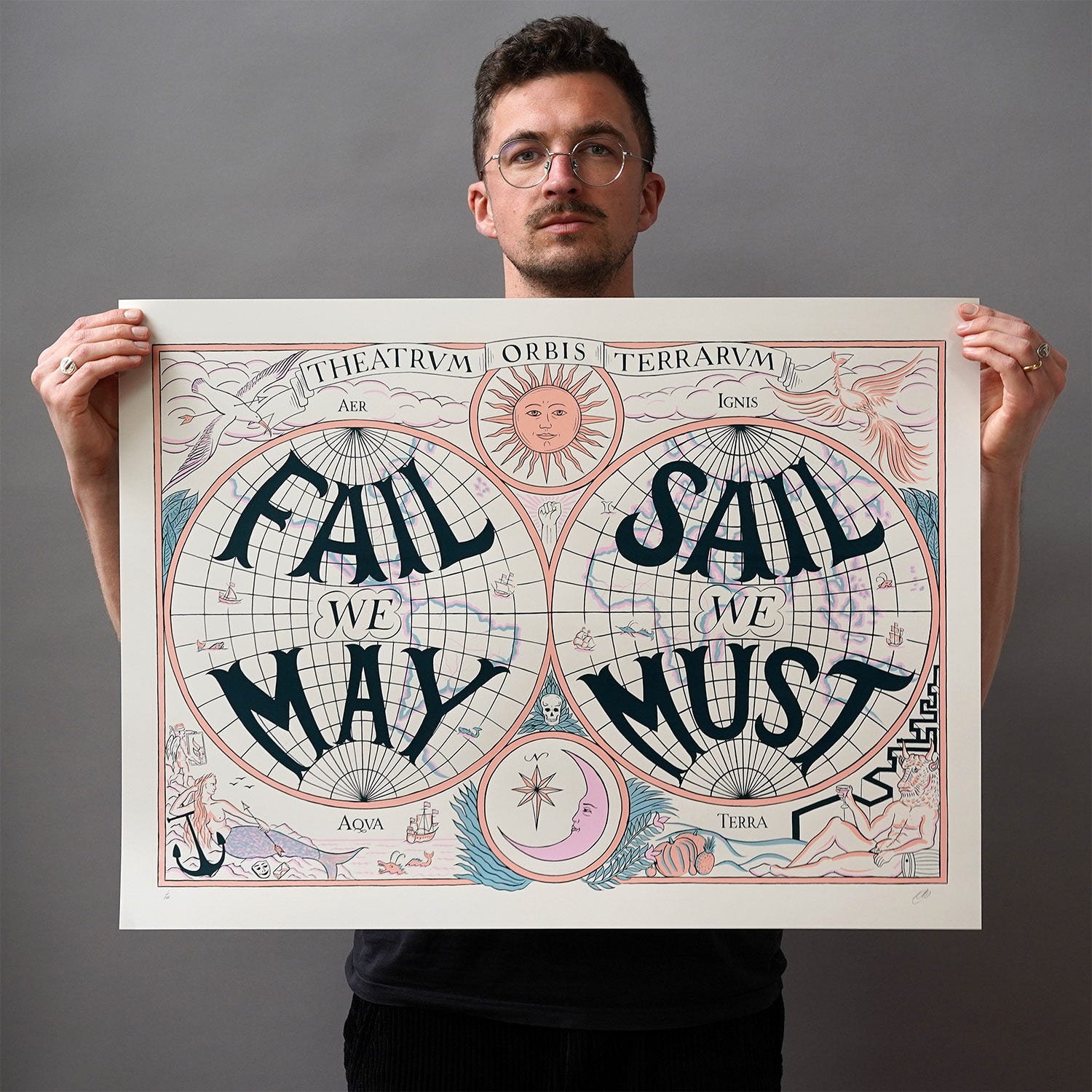
My classic Fail We May Sail We Must prints started life as physical painting and they end up as very physical hand pulled screen prints. But in between its all computer. The design comes from an original painting that was digitally photographed and uploaded to photoshop. The different colours were then separated out and printed off as acetates to expose the silk screens. I made a long video about the process earlier in the year where I skirted over the computer use because its the least sexy part of the process visually, but its critical to getting them made.
The computer is the meat in the hand made sandwich. Just as its to get that artwork from my plans chest onto your walls.
My praise for the computer might come as a surprise to you if you’ve followed my work for a while. I guess I’ve defined myself as a manual guy in a digital age. Someone who decided to root their technique in the near extinct craft of painting signs by hand. This decision wasn’t because I wanted to be some sort of Peaky Blinders adjacent revivalist, cosplaying in a flat cap, braces and leather shoes. But because these analogue skills were new and exciting to me having grown up knowing only digital.
How I do things has never been about a nostalgia for a time before silicone chips ruled our lives. It’s more of a belief in what the analogue still has to offer alongside the digital: a human touch, mistakes, soul.
The problem for the artist and sign painter in the digital age is that we’re always comparing up ourselves against the computer. Most of the signs I paint are simply a physical realisation of a computer mockup. I use a computer to make scale print out of a logo that was created on a computer, transfer the outline onto the surface and paint. Like the AI art this is quite boring.
But on the plus side that enamel paint elegantly brushed onto the surface looks so much better in reality than pixels on a screen. Clients are always really happy, excited to see something tangible happen for once. I get paid, go home and head back into the studio with a bit of breathing room to create something new for people’s walls.
And after all that computer love what I’m working on now is free from any digital meat in the sandwich. Because right now I’m going full analogue on my new edition and loving it.
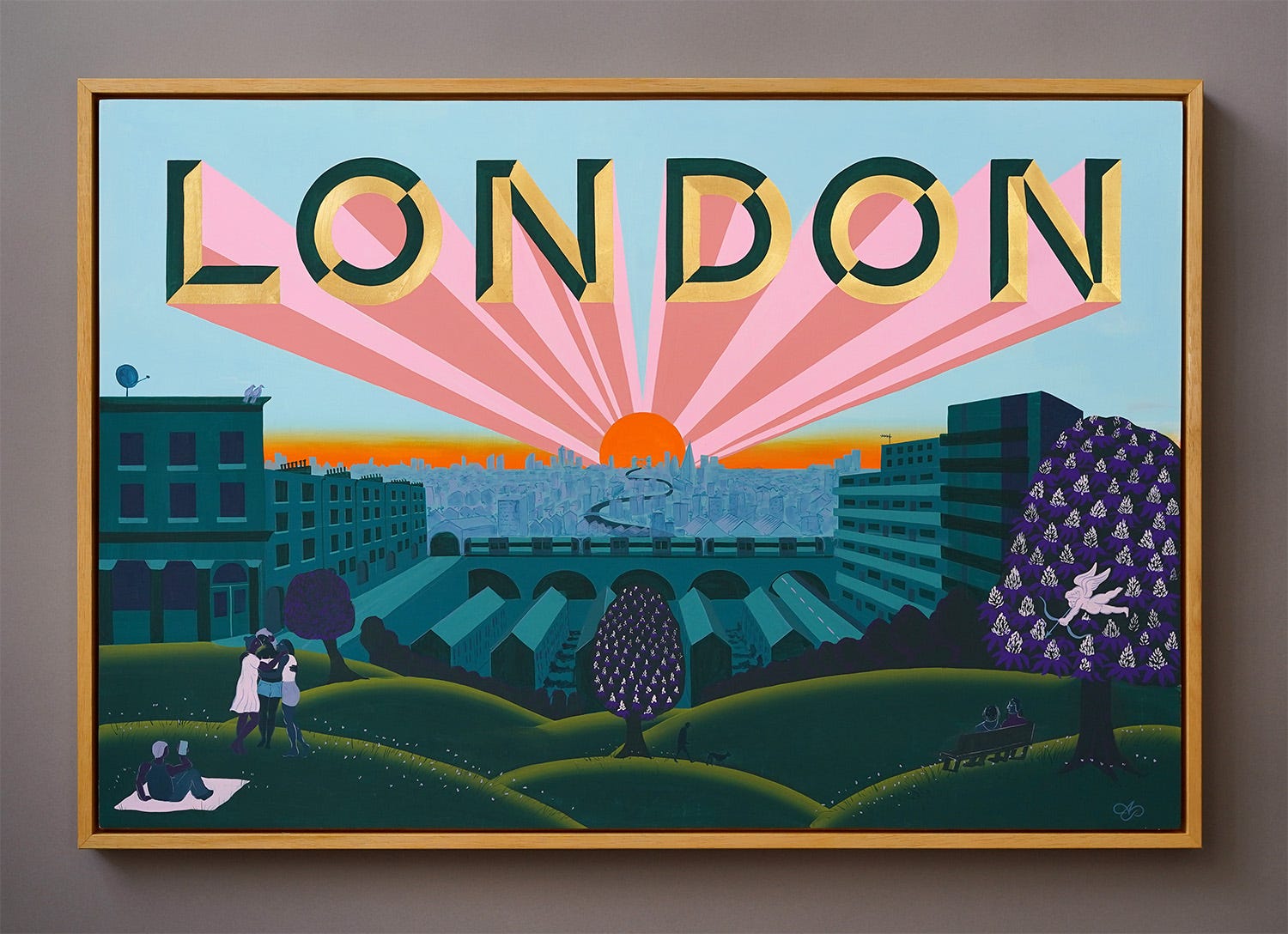
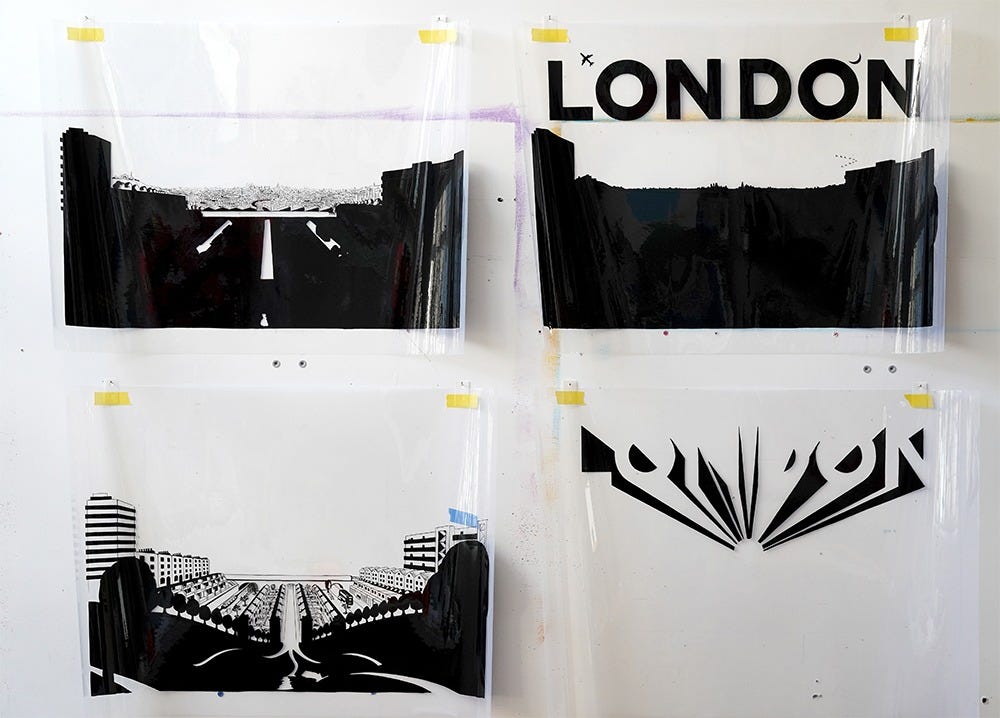
I’m working on turning this ‘LONDON’ painting I made earlier in the year into a screen print edition. But rather than simply photograph that painting and then digitally separating the colours to print off the acetates I’m actually manually painting each acetate by hand.
This is how it would have been done back in the dark ages before digital. Some lonely artworker at a print house sat at their drafting table painstakingly painting each colour onto separate sheets of acetate to use to expose the silkscreen stencils for printing.
I’ve actually made a screen print like this before when I created my Sun editions a few years ago. But for that print there were only two colours, so two acetates to paint and the design was relatively simple, just a sun with a face.
This one, however, has a lot more moving parts. There’s a whole miniature city of London in there, people getting pissed in a park and pigeons taking flight in the dawn light. To make it happen I need to paint a magnificent seven sheets of acetate for each of the colours in my scene. Getting them all to line up together and sing in harmony won’t be easy. There will be mistakes, but hopefully soulful ones. Like crackles and blips on vinyl records.
Why am I doing it like this? Why give myself the extra work, the stress and the anxiety? Is it because I want to make it look pre-digital and vintage? No. Is it because I hate AI and everything it stands for? Also no.
As much as I do hate AI I don’t make creative decisions to performatively spite it. Nor do I deliberately make things look older because I’ve been seduced by nostalgia for a rose tinted past.
I’m doing it for the mystery, for the enjoyment of the process and because I really don’t want to spend days and days in front of a screen on photoshop with my one wild and precious life.
Doing it this way allows my instincts as an artist to speak while I’m working. I can improvise.
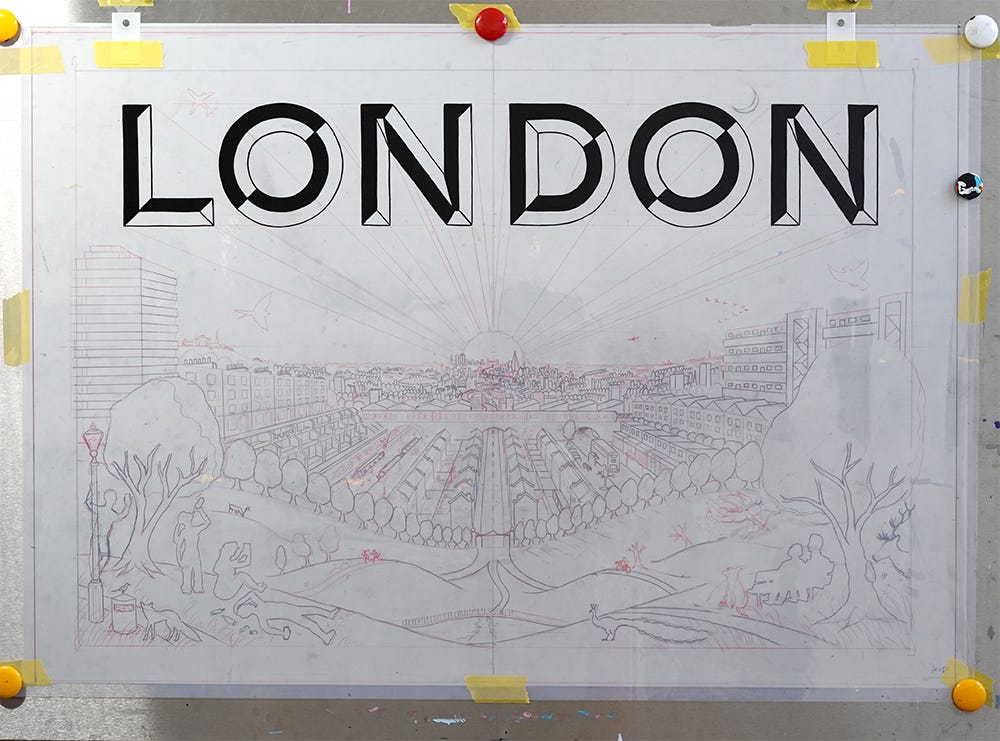
How it works is I have a master sketch with the bones of the design drawn out onto drafting film, a specialist kind of paper which is itself a relic of an age when architects used to draw their plans for buildings by hand rather than on CAD. I then lay each sheet of acetate over this sketch, clipping it in with registration tabs. Then I get my brushes out and start painting in where I want that colour to go with a very opaque One Shot Black gloss enamel. Its the brush strokes that form how the print will turn out.
So what I hope will happen in the final prints is that they will have a vivacity that feels more like a painting because they are, literally, created directly from my brush strokes. Time will tell if this works or not when I hand them over to Ali at Mansons Press next week to begin printing.
But what I know for sure already is how much fun I’m having doing it this way. And how much I’m learning about how I can apply this old way of doing things for future prints. Again, not because I think digital is “bad” somehow, but because this way of doing it is new and exciting for me creatively.
I also know now that taking some time to write about it has done me some good as well. I’ve tried to articulate the “why” more clearly to myself as well as you, my audience. During this writing blip I’ve questioned wether this Substack needs to exist at all. Like I say, its felt more like a burden rather than a place to enjoy expressing myself.
But perhaps its not dead yet. And maybe I need to shift my attitude to how I use it to release the shackles I’ve managed to impose on myself. Its the digital meat in the sandwich between my brain and yours after all. And as much as the self promotion game might be in a depressing spot right now that doesn’t mean you just don’t do it. We must hustle. As King Lea says “nothing will come from nothing”. Just rounding off this meandering return by quoting a mad old man, could AI do that?
I really enjoy the surprise of randomly timed updates.
And honestly, as soon as I sense too rigid a regularity with anything I subscribe to read I subconsciously zone out a little. The emails remain unread in my inbox with a vague promise to myself that I’ll “catch up” with them when I have more time. I never have more time, or time to dedicate to that anyway, so I ruthlessly tidy up my inbox every few months and out they go.
Life doesn’t run on a preemptive and predictable schedule for any self employed or creative being so why should your musings?
I hate that our attention spans have shrunk so drastically that reading your current piece was a genuine struggle of concentration! But a struggle I thoroughly enjoyed and found funny and interesting and left me feeling better about life and the crazy world we inhabit.
Really love your musings and the way you share your process and thoughts. Please keep writing (here or elsewhere - I know what you mean)